
Hair
Women's health
Men's health
Wellness
Hair
Women's health
Men's health
Wellness
Quick answer
HIFU for a double chin may modestly tighten mild to moderate loose skin under the chin and along the jawline, so it may soften a double chin that is mostly about looseness. HIFU treatment is a skin-tightening treatment, not a fat-removal or weight-loss treatment, so it is unlikely to be enough when the fullness is mainly fat or the shape of your jaw. An in-person assessment shows which type you have.

A double chin can come from fat under the chin, loose skin, the inherited shape of the chin and jaw, or a mix of these. Fat in this area is called submental fat, and the overall look is sometimes described as submental fullness, which simply means fullness under the chin.
Weight plays a part. Weight gain can cause extra fat to collect around the neck, while losing weight can leave the chin and neck looking loose. Ageing matters too: skin loses elasticity as we get older and makes less collagen, so the skin under the jawline can start to sag.
Family traits also count. Some people inherit a softer jawline or a tendency to carry tissue around the neck, even when they are not overweight. That is why a slim person can still have a double chin, and why your weight alone doesn’t tell you what is behind it.
Treating a double chin is generally a cosmetic choice. A new lump or swelling in the neck is a different matter. The NHS advises seeing a doctor if a lump gets bigger, hurts, is red or hot, is hard and does not move, or lasts more than two weeks. Don’t book a cosmetic treatment to deal with unexplained swelling.
It depends on what is causing it. HIFU is a reasonable option to discuss when mild to moderate loose skin is the main issue, and much less so when the fullness is mostly fat, bone structure or a lot of excess skin.
| What is mostly behind the double chin | Is HIFU a reasonable option to discuss? | Why |
|---|---|---|
| Mild to moderate loose skin | Yes, it may help, after an assessment. | Cleveland Clinic describes people with mild to moderate loose skin on the face and neck as good candidates for ultrasound skin tightening. |
| Mostly fat under the chin | Ask about other options. | Ultrasound skin tightening is described as lifting and tightening loose skin. Fat is approached in other ways, such as weight loss, fat-reducing procedures or surgery. |
| Fat and loose skin together | It may not be enough on its own. | Tightening the skin addresses only one of the two causes. Ask how the fat would be addressed. |
| Chin and jaw shape | Unlikely to change it. Ask whether a different assessment is needed. | Skin tightening works on the skin. Inherited bone structure is a separate matter, sometimes discussed with a surgeon. |
| Marked sagging or a lot of excess skin | Ask about other options. | The American Academy of Dermatology says skin tightening may not be helpful when there is a lot of sagging skin. |
Use the table to organise your questions, not to diagnose yourself. At your appointment, ask the doctor to name the main cause and explain how the suggested treatment relates to it.
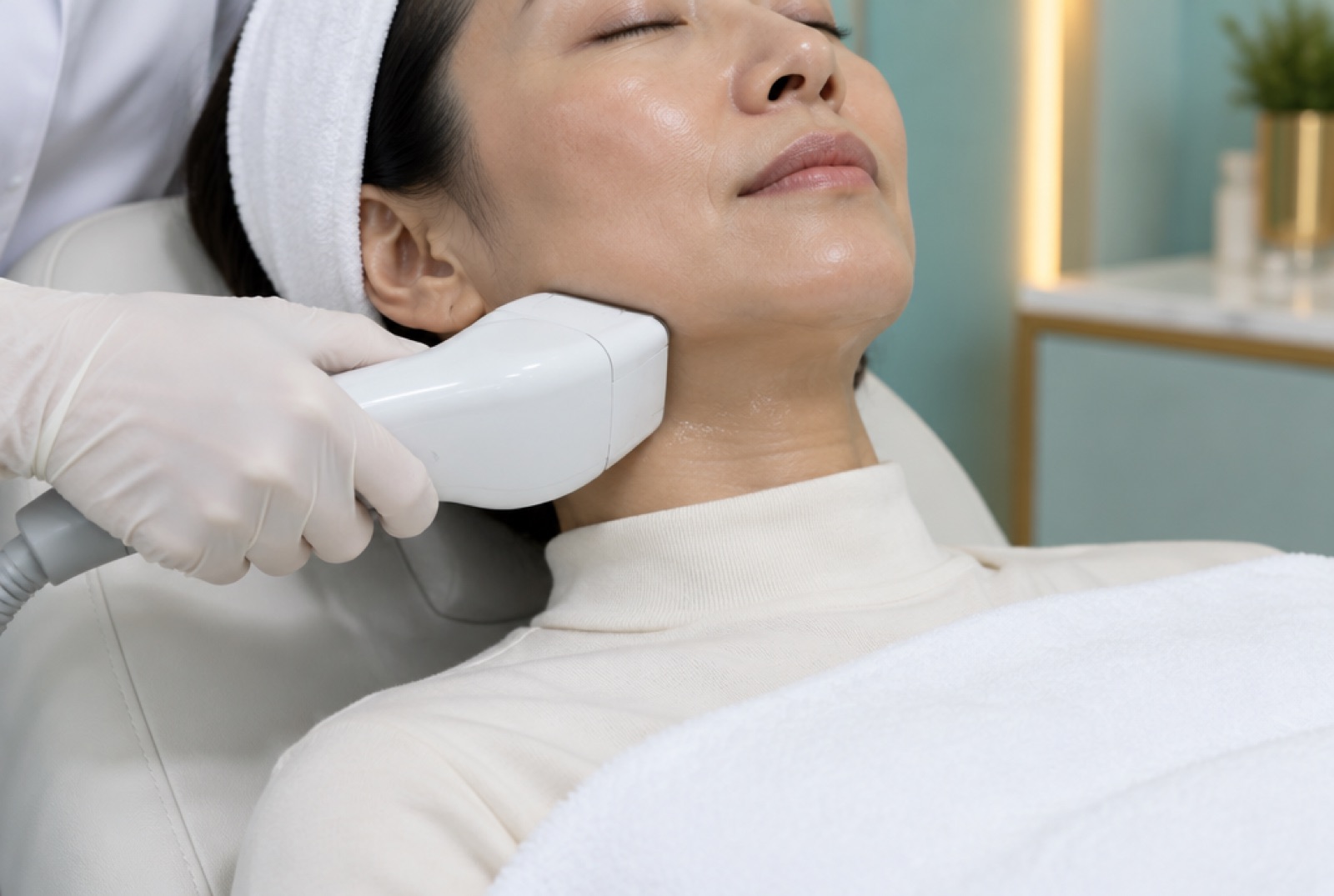
HIFU stands for high-intensity focused ultrasound. It sends focused ultrasound energy beneath the skin surface, where the heat can prompt the body to make more collagen. Cleveland Clinic lists the neck and the under-chin area among the places where ultrasound skin tightening can be used, and a reduced appearance of jowls among its possible benefits. The tightening appears gradually; it is a change in the skin, not in the structure of the jaw. Read what HIFU does to your face for the fuller explanation.
Not sure which option suits you?
Talk it through at a private assessment with our team.
It suits people whose main concern is mild to moderate skin looseness and who are comfortable with a modest, gradual change. It is less suitable when the fullness is mainly fat, when there is a lot of sagging, or when you want a big or quick change.
It may be worth discussing if:
Ask carefully about other options if:
Some people should check with a doctor first. The American Academy of Dermatology says a skin-tightening procedure isn’t right for anyone who is pregnant, has a skin infection or takes certain medications. Cleveland Clinic adds that people who are breastfeeding or have an autoimmune disease such as lupus or rheumatoid arthritis may not be good candidates and should speak with their healthcare provider. Tell the doctor about your medical history, your medicines and any implants, fillers or surgery in the area.
Expect a modest, gradual change that differs between people. A realistic “before and after” is a slightly firmer line under the chin and along the jawline, not a new jaw and not a full removal of the fullness.
On timing, the American Academy of Dermatology says that with one ultrasound skin-tightening treatment, most people see modest lifting and tightening within 2 to 6 months, and that additional treatments may bring more benefit. That is a general figure for ultrasound skin tightening, not a forecast for your chin, so ask your doctor when a review makes sense for you and what happens if there is little visible change.
The result does not last forever, and no single duration applies to everyone. Skin keeps ageing and collagen continues to decline with age. Read how long HIFU results last and ask how any repeat treatment would be decided for you.
Temporary redness, swelling, bruising and tenderness are the side effects usually described after ultrasound skin tightening. Cleveland Clinic notes that these are typically temporary, although in some cases the skin can stay tender for up to a month.
Less common but more serious problems are possible. The FDA’s information on ultrasound devices used for body contouring lists blisters, burns and nerve damage among the possible complications. That is not a personal risk estimate, but it is a reason to ask for a clear explanation of the risks before you go ahead.
Contact the clinic or a doctor promptly if you have severe or worsening pain, blistering, new weakness in the face or lasting changes in sensation. Don’t wait for a routine review if symptoms worry you.
It depends on what the treatment is aimed at. Options for fat, for loose skin and for underlying structure are not interchangeable, so compare each one against the cause of your double chin.
| Option | What it is aimed at | Things to know |
|---|---|---|
| HIFU skin tightening | Mild to moderate loose skin. | Modest, gradual tightening. Discuss its limits if fat is the main concern. |
| Fat freezing (cryolipolysis) | Pinchable bulges of fat. | The FDA says it is not for people with certain cold-sensitivity conditions. Reported complications include redness, bruising and swelling, and less commonly numbness, freeze burns or fatty tissue that grows instead of shrinking. |
| Fat-dissolving injections | Fat under the chin (submental fat). | Should be given only by a healthcare provider. The FDA lists bruising, lumps at the injection site, tissue damage and nerve injury around the jaw among reported problems, and warns against unapproved fat-dissolving products. |
| Thread lift | Lifting sagging skin with threads placed under the skin. | Cleveland Clinic describes the results as subtle and temporary. Possible complications include infection, bleeding, pulling or lumpiness. |
| Radiofrequency skin tightening | Loose skin, by heating the tissue beneath it. | The FDA lists blisters and burns among possible complications and says radiofrequency devices are not for people with active implants such as a pacemaker. |
| Liposuction or neck lift surgery | Liposuction removes fat. A neck lift removes excess skin and tightens the muscles. | Done by a plastic surgeon. Surgical risks include bleeding, infection, nerve injury and scarring, and surgery involves more recovery than non-surgical options. |
| Weight management | Overall excess body fat, where relevant. | The neck may look different after weight loss, but not always. Loose skin can remain. |
The right choice depends on whether fat, skin or structure is the main cause. Explore double chin treatment options and ask for an assessment of that distinction first. If several procedures are suggested, ask for the purpose and risks of each one separately.
Sometimes, in part. Overall weight loss through diet and exercise may reduce fat under the chin for some people, but it won’t necessarily change loose skin or an inherited jawline. There is no overnight fix, whether from exercises, skincare or a procedure.
Chin and neck exercises can strengthen the muscles in the area, but Cleveland Clinic notes that stronger neck muscles don’t automatically mean less fat, and that these exercises can’t replace healthy eating and regular physical activity. Start slowly, because doing them incorrectly can strain the jaw and neck.
If you are already at a healthy weight, don’t assume that losing more is the answer. Find out what is behind the fullness before making a weight-loss plan.
The cost depends mainly on the area treated, the number of sessions advised, whether another treatment is suggested alongside it, and what the assessment and follow-up include.
Ask whether the quoted area covers the chin, the jawline or the neck, and which parts matter for your concern. Check the terms of any package before paying, and ask how further sessions would be decided.
No. HIFU is a skin-tightening treatment, so it may firm mild looseness under the chin, but it should not be expected to remove a double chin completely. Fat and jaw shape are separate causes, so ask what the treatment is likely to leave unchanged.
There is no fixed number. The American Academy of Dermatology describes modest lifting and tightening after one ultrasound treatment, with possible further benefit from additional treatments, and Cleveland Clinic notes that some people need three or more sessions. Ask what your plan is based on and how your response will be reviewed before more treatment.
You may feel some discomfort during the procedure, and experiences differ. Tenderness afterwards is possible and usually temporary. Ask how discomfort is managed and which symptoms afterwards need advice.
An inherited jawline and loose skin can both create the look of a double chin without excess body weight. An assessment can tell these apart from fat under the chin.
Neither is better in general, because they are aimed at different things. HIFU is used to tighten loose skin, while fat freezing is used on pinchable fat, and each has its own risks. The first question is whether your double chin is mostly skin or mostly fat.
A double chin is usually treated as a cosmetic concern, although it often goes along with carrying excess weight. A new lump or swelling in the neck is different. See a doctor about any unexplained change instead of assuming it is a double chin.
It can be worth discussing when mild skin looseness is the main issue. It is not the answer for every double chin, so the cause needs to be identified before you choose a treatment. You can book an assessment at Westwood Clinic, ask your questions and take time to consider the recommendation.
Not sure which option suits you?
Talk it through at a private assessment with our team.